
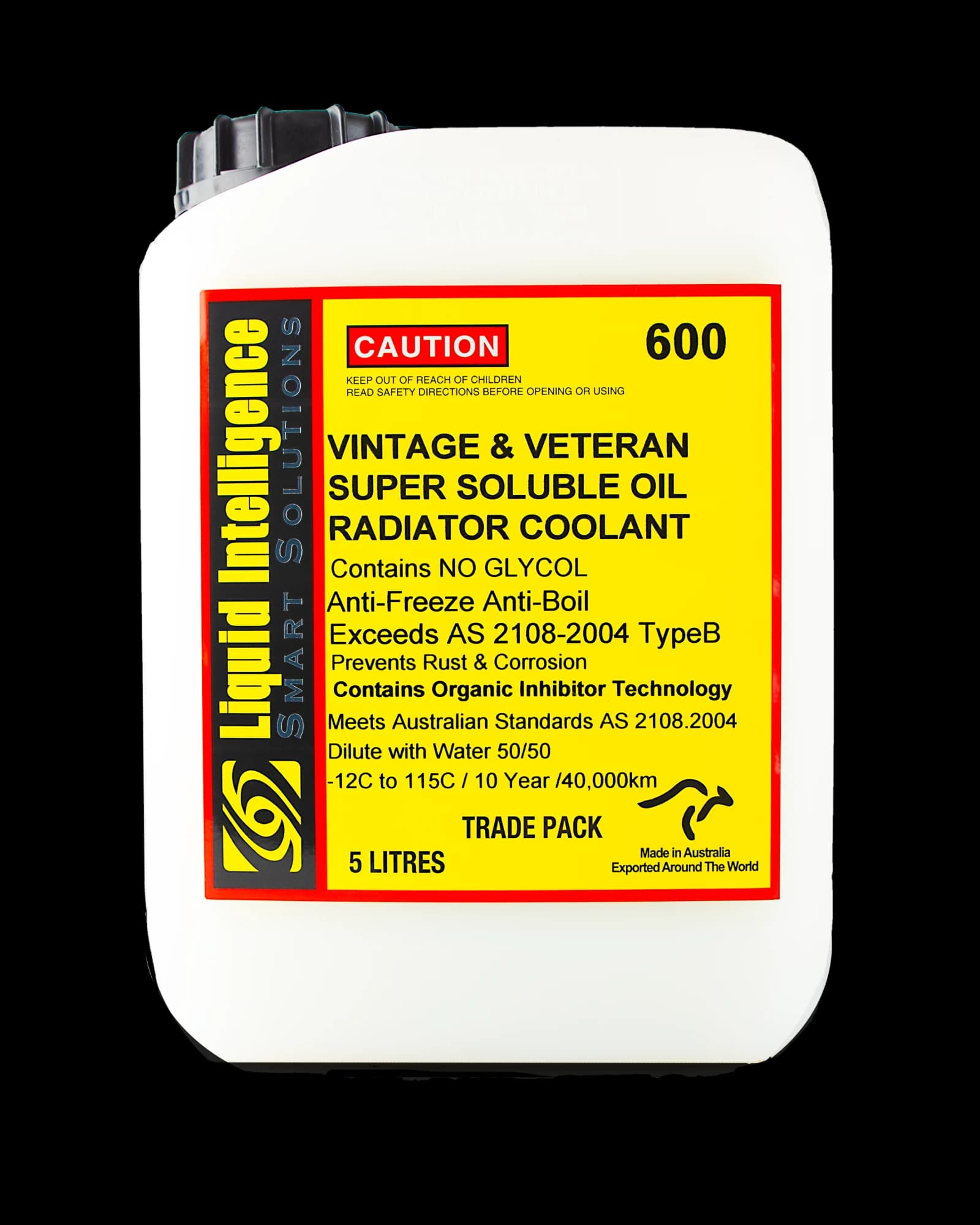
Liquid Intelligence No. 600
Vintage Soluble Oil Coolant
From$84
Choose size and buyDouble the heat transfer of glycol coolant. For overheating vintage and veteran cars.
- ✓Purpose-made for 1910–1960 vintage and veteran cars
- ✓Double the heat transfer efficiency of glycol coolant
- ✓Non-glycol, corrosion inhibited concentrate
- ✓5L makes 10L; 15L makes 30L ready-to-use
Vintage Soluble Oil Coolant
“This surprisingly efficient new coolant takes its origins from the past: old-fashioned soluble oil, reformulated with remarkable new technologies. 100% guaranteed at preventing overheating and all types of corrosion. It really does do exactly what it says.”
✓ 100% satisfaction guarantee: you have everything to gain and nothing to lose.
Liquid Intelligence 600 is a non-glycol, corrosion-inhibited antifreeze and anti-boil coolant made specifically for vintage and veteran cars, trucks and tractors built between 1910 and 1960, with pressurised, unpressurised or thermosiphon cooling systems.
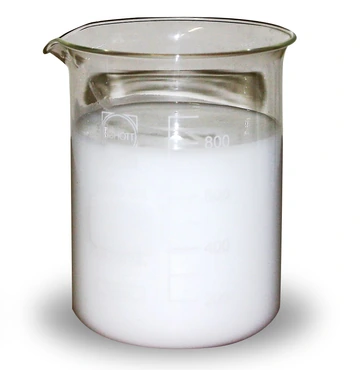
It's an oil and water emulsion: soluble oil, reformulated with a unique combination of inhibitors. It has more than twice the heat transfer efficiency of a glycol coolant, which makes up for the small, low-flow water pumps of older engines and can bring operating temperatures down significantly.
It's the ultimate protection against corrosion, cavitation, scaling and oxidisation, with freeze-up protection to −12°C and boil-over protection, all without glycol. In a low or no pressure system its boiling point is well above tap water's or a 50% antifreeze's. The concentrate makes twice its volume of coolant: 5 litres makes 10, and 15 litres makes 30.
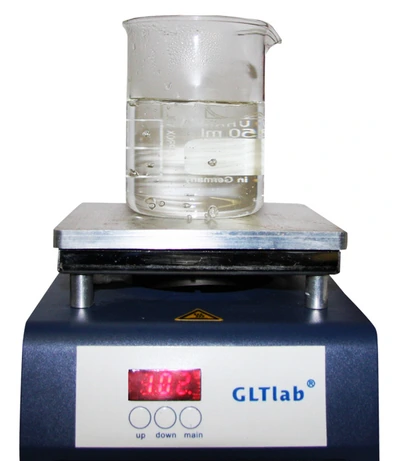
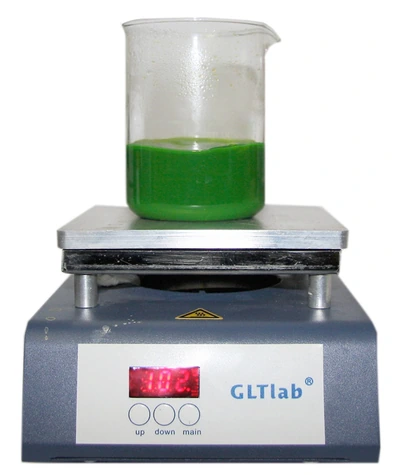
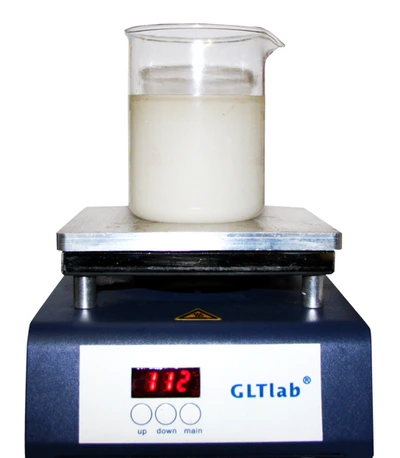
Guide: Fixing overheating in vintage and veteran cars
Why it runs cooler
Many vintage and veteran vehicles have small water pumps with very low flow rates. They may have coped in countries where half the year is below freezing, but they don't do so well in an Australian summer, or in today's traffic. A low-flow system needs a coolant with high thermal conductivity: the higher it is, the less flow it takes to carry away the same amount of heat. 600's thermal conductivity is 0.609W/m·K, more than twice a glycol coolant's 0.300W/m·K.


The little man with a bucket
Picture a little man whose only job is to keep a car cool, carrying buckets of hot coolant from the engine to the radiator. Glycol raises a coolant's boiling point but carries heat poorly, so in a modern car he has to run to keep up, which a modern high-flow water pump easily does. In a vintage car he can only walk. The only way to stop it overheating is to give him a coolant that carries far more heat in every bucket. The animations at the top of the page show the two.
Heat transfer and viscosity
600's specific heat is 4.2 joules per gram per °C. Its boiling point is lower than some glycol coolants, but its heat transfer is at least 20% higher, so older engines often run much cooler with it, especially on very hot days. Its viscosity is ultra-low (0.652 at 40°C and 0.354 at 85°C), which cuts flow resistance and raises fluid velocity, helping it carry heat away.
Galvanic corrosion, the silent killer
Galvanic corrosion, or electrolysis, happens when an anode metal and a cathode metal are connected through a conductive solution: the coolant. The anode metals corrode. In a vintage cooling system those are cadmium, magnesium, aluminium, zinc, steel and iron, cast iron, lead, solder, tin and nickel; the cathode metals are nickel, brass, copper and bronze.
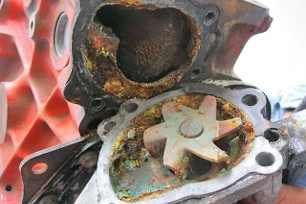
A coolant's conductivity depends on its dissolved solids, and corrosion inhibitors are dissolved solids, so ordinary coolants are both the catalyst and the conductor for galvanic corrosion. A vintage copper and brass radiator is held together with lead and tin solder, an anode metal: as it corrodes, the core and tanks develop leaks and weak spots.

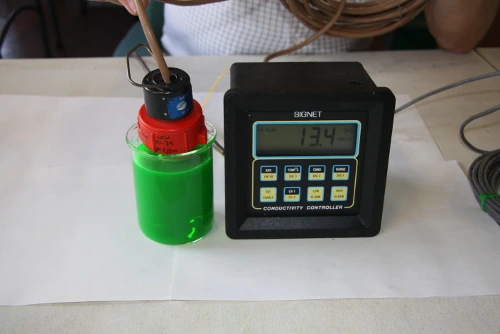
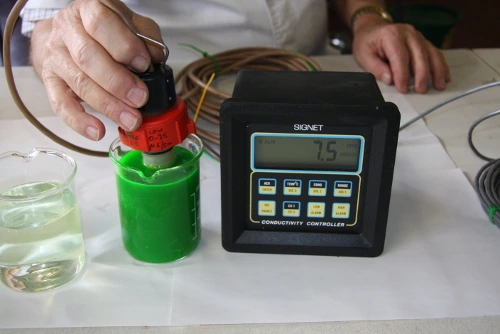
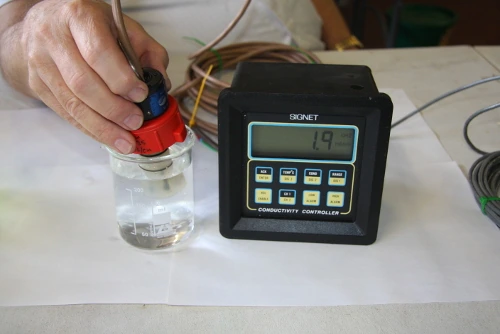
600's electrical conductivity is almost zero: 134 times lower than radiator water with a 5% corrosion inhibitor, 75 times lower than a 50/50 glycol coolant, and 19 times lower than Sydney tap water. That prevents or greatly reduces galvanic corrosion.
Corrosion testing and safety
A vintage cooling system contains copper, solder, brass, steel, cast iron and cast aluminium, all prone to corrosion. 600 meets or exceeds AS 2108.2004 Type B, the Australian Standard coolant test methods, which mirror the Japanese, British and American standards and most OEM coolant standards.
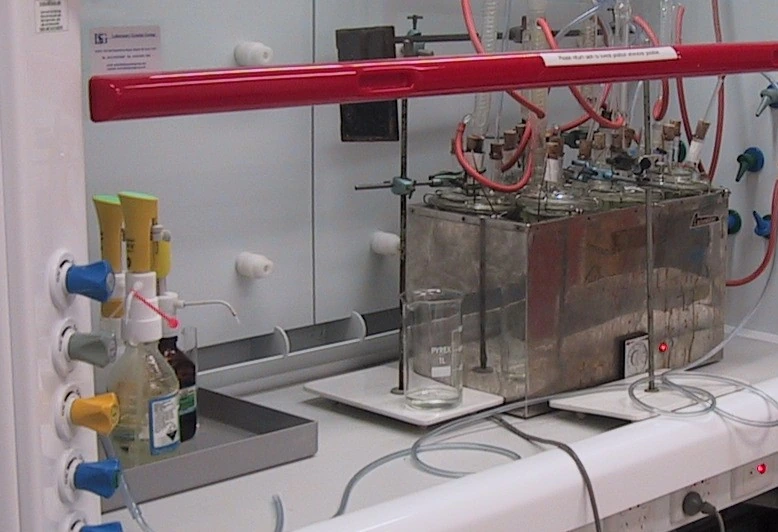
In the ASTM D1384 glassware corrosion test, the coolant is diluted with "corrosive water", with 100ppm each of sulphate, chloride and bicarbonate added to stress it, and boiled for 14 days with coupons of each cooling system metal. The weight each coupon loses shows how much it corroded. The test is repeated three times for verification.
600 isn't classed as dangerous goods under the WHS Regulations and the ADG Code, isn't considered toxic to people or animals, and is environmentally friendly.
or 4 interest-free payments of $21 with 
Secure checkoutVisa
- ✓ Prices in Australian dollars and include GST
- ✓ Direct from the manufacturer: formulated and made in Minchinbury, NSW
- ✓ Free technical phone support before and after purchase
Free expert help
Questions about your vehicle, or how to get the best result? Call Peter, who formulated it.
Call 1800 441 163Or 02 8188 2060 · 7am–7pm, seven days